

In today’s digital landscape where AI is revolutionizing the SEO industry, many businesses are turning to this technology for their online marketing efforts. However, common misunderstandings of AI SEO can cost you valuable opportunities or, worse, the search rankings you’ve worked hard to achieve. This article addresses these misunderstandings that business owners frequently encounter and provides smart strategies for leveraging AI to maximize your business benefits.
Table of Contents
What is AI SEO ? Why Understanding Misunderstandings of AI SEO Matters for Modern Businesses
AI SEO refers to using artificial intelligence to analyze, optimize, and enhance websites to align with Google’s algorithms. This includes keyword analysis, content creation, and updating website structures to match current search patterns. If you’re new to this concept, our easy guide to SEO provides a solid foundation.
Misunderstandings of AI SEO began to emerge as businesses noticed significant changes in online search behavior. Previously, people searched with short phrases like “Japanese restaurant.” Now, they engage in more natural conversations with AI and expect immediate, relevant answers—not just website links to click through.
Who Benefits from AI SEO Despite Common Misunderstandings?
AI SEO is suitable for various business groups looking to improve their digital marketing effectiveness once they overcome these prevailing misunderstandings:
- Small and medium business owners (SMEs) with limited resources who want to compete with larger brands online. AI helps save time and costs in SEO implementation.
- Startups seeking rapid growth and brand awareness in a short time. AI analysis of markets and competitors helps develop more precise strategies.
- Businesses with large websites containing numerous pages and content. AI excels at managing and optimizing large volumes of content.
- Digital marketers looking to improve efficiency. AI reduces repetitive tasks and analyzes big data effectively.
- Businesses in rapidly changing industries such as technology, fashion, or beauty that need to constantly update trends and keywords.
However, AI SEO may not be suitable for highly specialized businesses requiring deep knowledge that AI doesn’t yet fully understand. It’s also less ideal for businesses that need to create personalized content with specific emotional elements, which still primarily rely on human creativity.

8 Dangerous Misunderstandings of AI SEO Business Owners Should Avoid
1. Believing AI Can Handle All SEO Tasks Without Human Assistance
Many believe AI can manage everything from keyword analysis and content creation to strategy development. This is perhaps the most dangerous of all misunderstandings of AI SEO.
Reality: AI can help with many tasks but cannot completely replace human decision-making and creativity. AI still lacks deep understanding of business contexts, target audience needs, and cannot convey brand uniqueness like humans. Using AI effectively in SEO means employing it as an assistant, not the primary worker. For a deeper understanding of what AI SEO actually involves, consulting industry resources can be helpful.
2. Believing Keyword Density is Still the Most Important Ranking Factor
This misconception stems from the old SEO era that emphasized keyword stuffing, with the belief that you needed to include keywords in 2-5% of your content.
Reality: Google no longer focuses on keyword quantity but prioritizes natural, quality content. Google’s AI understands meanings, contexts, and connections between words in articles. Excessive keyword stuffing may cause Google to view your content as spam and lower your rankings.
3. Thinking AI-Generated Content Ranks Better Than Human-Written Content
Among the most persistent misunderstandings of AI SEO is the belief that AI-generated content ranks better because AI can analyze and use keywords more precisely.
Reality: Google doesn’t care who writes the content but examines whether it’s high-quality and addresses readers’ needs. Content created solely by AI without human refinement often appears repetitive, unnatural, and may not meet users’ actual needs. This results in readers getting bored and leaving quickly (high bounce rate), causing Google to view the content as low-quality.
4. Believing Longer Content is Always Better for SEO
A common misunderstanding of AI SEO is thinking longer content is always better, leading to unnecessarily lengthy articles.
Reality: Appropriate length depends on the topic and article purpose. Google prioritizes addressing searchers’ needs over length. Sometimes concise, to-the-point content works better than long, verbose content. Quality always trumps quantity in modern SEO.
5. Thinking More Backlinks Lead to Higher Rankings, Especially When Using AI
The misconception that backlinks are one of the top factors in ranking, and more is better (especially when created using AI), represents another fundamental misunderstanding of AI SEO.
Reality: Gary Illyes (Google’s Search Advocate) has stated that backlinks are no longer among the top three SEO factors. Google’s current algorithm prioritizes quality over quantity. Quality links come from credible websites with content relevant to yours. Using AI to create backlinks without considering quality could result in Google penalties.
6. Believing New Websites Can't Compete with Established Ones, Even with AI Help
Many believe new websites or businesses can’t compete with long-established ones in the market, a misunderstanding of AI SEO that limits potential growth.
Reality: Google primarily considers website and content “quality,” not age. With good content, proper on-page SEO structure, user-friendly design, and appropriate optimization, you can outperform competitors who’ve been around longer. AI can help analyze and recommend ways to improve your website development for better competition.
7. Worrying About Low-Quality Links Pointing to Your Website
Many worry that low-quality links pointing to their website will harm their SEO rankings, a concern rooted in misunderstandings of AI SEO.
Reality: Google already has systems to detect low-quality websites and won’t consider those links in ranking. You don’t need to worry excessively about this issue. If you’re still concerned, you can use the Disavow Links tool in Google Search Console to tell Google you don’t want those links affecting your website ranking.
8. Believing Good SEO Rankings Automatically Increase Sales
The misunderstanding that simply ranking well on Google will automatically boost sales reflects a fundamental misunderstanding of AI SEO’s purpose.
Reality: Good SEO ranking is like advertising to make people aware of your website but doesn’t guarantee sales. Other factors like user experience, product or service quality, easy ordering process, and customer communication all affect purchasing decisions. AI can help analyze user behavior and suggest improvements but can’t guarantee sales. Learn more about increasing sales with AI SEO in our detailed guide.
What Happens When SEO Relies Too Heavily on AI? The Consequences of Misunderstandings of AI SEO
1. Content Lacks Human Touch and Misses Search Intent
AI may create grammatically correct content but often lacks deep human understanding. AI-generated content typically:
- Uses overly formal or repetitive language
- Lacks tone or perspective that communicates brand personality
- Doesn’t understand searchers’ true intentions
When readers find content uninteresting or irrelevant, they quickly leave, resulting in high bounce rates, which Google may interpret as low-quality content.
2. Lacks Credibility in E-E-A-T
Many misunderstandings of AI SEO overlook E-E-A-T factors that Google values, which include:
- Experience
- Expertise
- Authority
- Trust
AI cannot provide personal experience or specialized expertise like real people, especially in topics requiring high credibility such as medicine, finance, or law. Overreliance on AI may make content less credible to both readers and Google.
3. Risk of Google Ranking Reduction or Deindexing
Google frequently updates its algorithm to address low-quality AI content:
- In March 2024, Google downranked content produced solely by AI without added value
- By 2025, Google is using AI to better detect repetitive and meaningless AI-generated content
Overreliance on AI without human refinement or added value may put websites at risk of Google penalties.
4. Content May Duplicate Other Websites
5. Missing Opportunities for Distinctive Branding
How to Use AI in SEO in a Balanced Way: Overcoming Misunderstandings of AI SEO
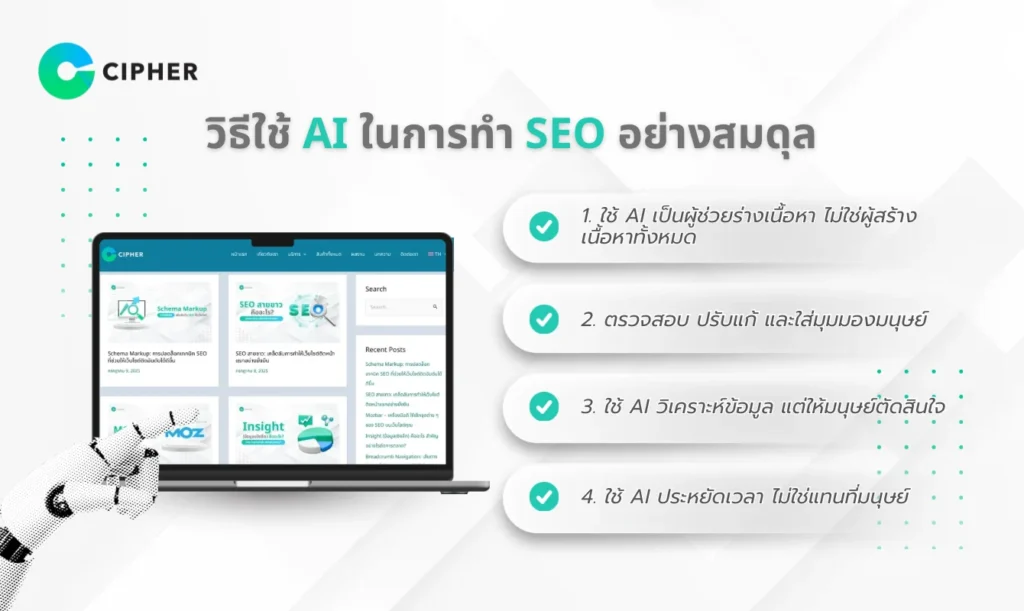
1. Use AI as a Content Draft Assistant, Not the Complete Creator
2. Review, Edit, and Add Human Perspective
3. Use AI for Data Analysis, But Let Humans Make Decisions
4. Use AI to Save Time, Not Replace Humans
Balanced AI SEO Services from CIPHER: Addressing Misunderstandings of AI SEO
At CIPHER – digital experts, we understand the misunderstandings of AI SEO business owners often encounter and recognize the importance of balanced AI use to maximize business benefits. We offer services that combine professional team expertise with modern AI technology:
1. SEO Analysis and Strategy with Human-Supervised AI
2. Quality Content Creation Balancing AI and Human Elements
3. Website Optimization for AI-Friendliness with Deep Understanding
4. Monitoring and Analysis with AI, But Strategy Adjustments by Humans
We use SEO analysis tools to continuously track and analyze SEO results, but strategy adjustments are made by our expert team who deeply understand your business. We perfectly blend technology and human expertise.
Conclusion: Moving Beyond Misunderstandings of AI SEO
AI SEO isn’t about choosing between AI or humans but creating balance between both. Misunderstandings of AI SEO represent significant barriers to online marketing success. At CIPHER, we combine AI strengths (accuracy/speed) with human creativity to intelligently leverage AI, helping your business outperform competitors and truly communicate with your target audience. We’re ready to partner with you to overcome these misunderstandings of AI SEO and effectively increase sales through AI SEO.

Frequently Asked Questions About Misunderstandings of AI SEO
Will using AI to create content cause Google to penalize our website?
How can we use AI SEO most effectively without falling prey to misunderstandings?
Can small businesses compete with large businesses in AI SEO despite common misunderstandings?
How will addressing misunderstandings of AI SEO affect our future strategy?
Understanding the true role of AI SEO is transforming the industry by 1) making data analysis more accurate, 2) helping create content that better addresses Search Intent, and 3) improving the ability to predict trends and user behavior. However, human creativity and understanding will remain important.
Therefore, the future of SEO will be a balanced combination of AI and humans working together to achieve optimal results.