

In today’s era, AI is completely transforming the information search industry, making traditional SEO strategies potentially ineffective in winning over Google. Every executive needs to adapt their thinking to handle this significant change. This article will explore long-term AI-powered SEO strategy planning approaches that help your business not just “be found” but also become the “answer” that AI chooses to present to users.
Table of Contents
When SEO World is Revolutionized by AI: Why Executives Should Care

Consider this: today, people search on Google more than 3.5 billion times per day, or over 40,000 times per second (according to the latest statistics). Pushing your website to the top rankings to achieve your website traffic goals is therefore crucial for every business. But what’s interesting is that search behavior and Google’s display methods are changing rapidly.
Now, Google AI Overviews is no longer just an experimental feature but has become an essential part of search results pages. When users ask complex questions and immediately receive answers synthesized by AI, traditional website clicking behaviors are beginning to disappear. Your SEO techniques must adapt to this trend.
The key question for modern SEO strategy development is no longer just “How do we rank?” but “How do we become the information source that AI selects to answer searchers?”
Who Benefits from AI-Era SEO Strategies?
Before diving into details, let’s see which groups this SEO strategy approach is suitable for:
- Senior executives looking to adapt to the digital era: CEOs, CMOs, or executives who need to understand online marketing directions for long-term organizational planning
- Small and medium business owners: who want to maximize their budget when competing with larger brands
- Digital marketing managers: who need to adjust their marketing plans and propose new concepts for executive approval
- New entrepreneurs: who need to establish strong online business foundations from the start
- Knowledge-based businesses: such as education, finance, and health sectors that need to present accurate and credible information
AI-powered SEO strategy planning is especially suitable for organizations ready to invest long-term and wanting to build sustainable online advantages to meet ambitious website traffic goals.
The New SEO Equation in the AI Era: From "Clicks" to "AI Citations"
Forget the old equation of “Keywords + Backlinks = Traffic.” The new SEO strategy equation in the AI era is:
Topic Expertise + Structured Information + Credibility = AI Citations
Having your content cited as an answer by AI in search result boxes is a more powerful indicator than traditional rankings. It’s like a system endorsement saying “you are the best answer,” which affects your business’s long-term growth and is a key goal of modern SEO.
7 Core Strategies for Long-Term SEO Strategy Planning with AI
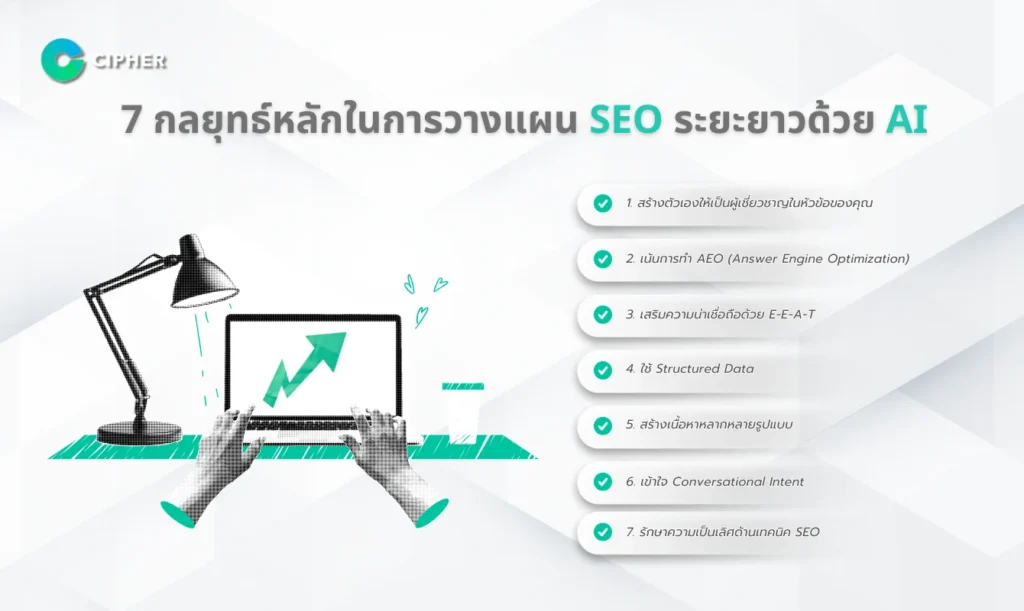
SEO strategy planning in the AI era requires a new perspective and approaches adapted to the changing environment. Here are 7 core strategies executives should implement:
1. Establish Yourself as an Expert in Your Topic
Focusing on keyword-by-keyword matching is an outdated concept. AI and Large Language Models (LLMs) understand content as “relationship networks” of various concepts. To win in this field and achieve your website traffic goals, you must establish yourself as an expert in those topics so AI views your site as a credible “knowledge hub.” This is the heart of analyzing with Ahrefs for long-term SEO strategy.
Practical implementation:
- Create comprehensive Pillar Pages covering main topics thoroughly
- Develop Cluster Content that delves into specific aspects
- Connect everything with internal links to form a complete knowledge network
2. Focus on AEO (Answer Engine Optimization): Not Just Being 'Found' but Being 'Selected'
AEO means designing content ready for AI synthesis or “ready to use,” helping AI efficiently extract information to create answers. This is a crucial part of SEO strategy that will help your content be selected as answers by AI.
Practical implementation:
- Clearly divide content into sections
- Set H2, H3 headers as questions people actually ask
- Use bullet points, tables, and lists to break down complex information for easier understanding
- These elements are premium raw materials that AI likes to use
3. Enhance Credibility with E-E-A-T: Trustworthiness is the Heart of the New Game
In an era where information floods the world and mixes between human and AI-created content, credibility is most important. The E-E-A-T principle (Experience, Expertise, Authoritativeness, Trustworthiness) isn’t just general guidance but acts like a “Trust API” that AI uses to evaluate information source quality, especially “Experience” which proves your content comes from real experience. Your SEO strategy must prioritize building this credibility.
Practical implementation:
- Display credible author backgrounds
- Present case studies supported by real data
- Add genuine customer testimonials or endorsements on landing pages to show real usage
4. Use Structured Data: Speak to AI in a Language it Understands
Structured Data or Schema Markup serves as a “bridge” connecting your website with AI, labeling “this is a review,” “this is a question and answer,” “this is an event.” This helps AI understand your information immediately without guessing. This is a crucial factor in effective SEO.
Practical implementation:
- Use Schema that matches your business
- For e-commerce sites, use Product Schema
- For information pages, use FAQPage Schema
- For blogs, use Article Schema
- This is a technical investment that pays off long-term
5. Create Diverse Content Formats: Increase Visibility Opportunities
AI Overviews work in a multi-modal way, not just displaying text but also pulling images, videos, and infographics to supplement answers. Creating only one type of content limits your brand’s “visibility area.” Good SEO strategy planning must cover creating multiple content formats to meet website traffic goals.
Practical implementation:
- Create “answers” in multiple formats
- Make short videos on YouTube/TikTok that answer specific questions
- Design infographics that summarize important information for easy understanding
- Include descriptive image alt text
6. Understand Conversational Intent: Read the Mind of Searchers
People talk to AI like they talk to friends. Search terms are complex and hide deeper intentions. Understanding just keywords isn’t enough anymore; you need to understand the entire “learning path” hidden in that question. Effective SEO strategy must emphasize understanding searchers’ true intentions.
Practical implementation:
- Use tools to analyze “related questions” and “people also ask”
- Not to find more keywords, but to understand how searchers think
- Create anticipatory content that answers questions in advance
7. Maintain Technical SEO Excellence: A Foundation That Can't Be Overlooked
Even if you focus on the 6 points above, if your technical SEO has problems, everything could fail. This is the infrastructure that must be prioritized in SEO strategy planning.
Practical implementation:
- Prioritize Core Web Vitals and Mobile-First approach
- Manage Crawl Budget by creating an orderly website structure
- Remove low-quality or duplicate pages
- Develop a complete Sitemap so AI Bots can collect your website information optimally

Long-Term SEO Strategy Planning Process for Executives
1. Find and Analyze Keywords That Real People Search For
Before starting your SEO efforts, understand what your target audience searches for and how:
- Brainstorm and ask customers about keywords they actually use
- Use tools like Google Keyword Planner to find related keywords
- Prioritize keywords based on business relevance
- Analyze which keywords suit each step of the customer journey
2. Match Keywords with Content That Meets Needs
Once you have a keyword list, proceed with your SEO strategy by:
- Checking which other websites use those keywords in topics
- Checking which other websites use those keywords in topics
- Seeing which of your pages already have desired keywords
- Creating a content development plan using all collected information
3. Develop Excellent Quality Content Adapted for AI
This step requires attention to detail in your content creation:
- Design Meta titles 50-60 characters long with brand name on the right
- Write clickable Meta descriptions within 120-160 characters
- Use clear headers between 20-50 characters
- Pay attention to anchor text and image names
- Plan a content calendar covering all dimensions
4. Build Internal and External Linking Systems
Linking is extremely important for credibility in SEO strategy planning:
- List all pages on your website and analyze relationships between them
- Plan systematic internal linking
- Develop external linking strategies by collaborating with relevant but non-competing websites
- Regularly check links to avoid broken ones
5. Measure and Continuously Adjust
Good SEO strategies need constant measurement and improvement to meet website traffic goals:
- Use Google Search Console to track performance
- Check website loading speed on mobile with Google Test My Site
- Analyze user behavior and improve content
- Monitor algorithm changes and keep strategies up-to-date
AI SEO Strategies for Different Business Types
For E-commerce Businesses:
- Focus on detailed Product Schema
- Create impartial product comparison content
- Use real customer reviews to enhance credibility
- Create comprehensive product FAQs
For E-commerce Businesses:
- Focus on detailed Product Schema
- Create impartial product comparison content
- Use real customer reviews to enhance credibility
- Create comprehensive product FAQs
For Professional Service Businesses:
- Emphasize highest E-E-A-T by showing detailed provider backgrounds
- Create case studies with in-depth information and measurable results
- Make FAQs covering technical questions clients often ask
- Create content demonstrating expertise in that field
For Content and Media Businesses:
- Focus on topic expertise and creating comprehensive content
- Fully utilize Article Schema
- Prioritize reviews on Google Business Profile
- Create content answering specific local area questions
Caution: 4 SEO Mistakes Executives Often Overlook
Executives should avoid these mistakes that can harm SEO performance, especially on mobile:
- Using too many special effects
If necessary, ensure they use mobile-supporting technologies like HTML5. If they slow down your site, remove them and design so users can achieve their goals on a single page. - Full-screen ads or pop-ups
Instead of using pop-ups for information collection, create dedicated pages with auto-fill features for convenience. - Difficult-to-use websites
Users should easily scroll up and down. If they must also scroll sideways, usage becomes complicated. High-quality images should be easy to zoom. - Using confusing “View Full Size” buttons
Users often wonder what “full size” means. Create responsive websites that adjust to screen sizes and design finger-friendly buttons.
Long-Term AI SEO Planning Services from CIPHER
At CIPHER, we’re not just an ordinary SEO agency but a partner who will help your business become a leader in the AI Search era with comprehensive SEO strategy services:
1. Develop AI-Powered SEO Strategies
2. Build Your Topic Expertise
3. Create AI-Optimized Content
4. Enhance Credibility with E-E-A-T
5. Install Powerful Structured Data
6. Maintain Technical Excellence
We check and improve your website’s infrastructure fundamentals, from website development, loading speed, to Mobile-First approach and Core Web Vitals, supporting long-term SEO strategy planning.
Conclusion
SEO isn’t dead but has evolved into a smarter game measured by “substance.” The winners in modern SEO strategy development are those who best “teach” AI by creating valuable, credible, and useful content for users following expert guidelines. At CIPHER, our expert team is ready to help you increase sales with AI SEO and make your brand “the answer AI chooses” to achieve your website traffic goals. Contact us today at 081-633-3636.