

Selling products online today isn’t just about displaying attractive images and waiting for customers to make random purchases. It requires good organization, especially regarding product categorization. An effective Product Category system helps customers quickly find what they’re looking for and creates a positive shopping experience. Your business might be missing numerous sales opportunities if your product category system isn’t adequate. In this article, CIPHER will explore what a Product Category is, why it’s important, and how to organize it effectively!
Table of Contents
What is a Product Category?
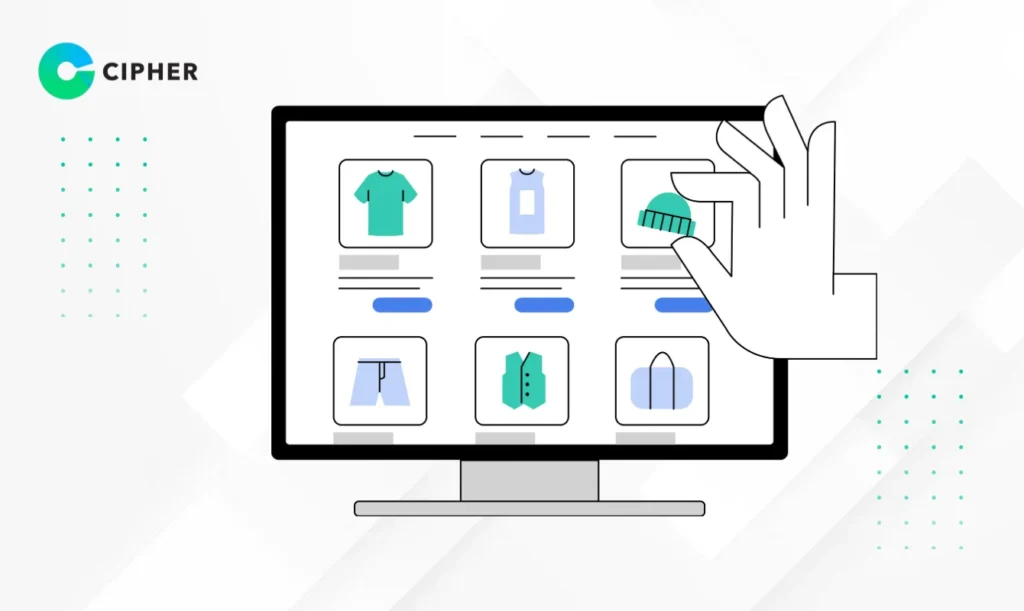
A Product Category is a grouping of similar products with comparable characteristics or properties, making it easier for users to search for items quickly and efficiently. Good product categorization prevents customers from feeling confused when visiting your website or application.
It’s similar to organizing a physical store with different zones. If you’ve ever walked through a department store, you’ve seen how spaces are divided into sections like clothing, food, and electronics, making it easier to find what you need. Similarly, with Product Categories and good website navigation design, your customers can find what they’re looking for more quickly.
Why are Product Categories Important for Online Businesses?
Improve Customer Experience
Increase Sales Opportunities (Cross-Selling / Up-Selling)
Intelligent product categorization can increase your sales beyond expectations. When customers view products in a particular category, you can:
Intelligent product categorization can increase your sales beyond expectations. When customers view products in a particular category, you can:
Recommend items often purchased together (Cross-Selling) – for example, people buying mobile phones are often interested in cases and screen protectors
Present higher-grade products (Up-Selling) – such as showing phones with better specifications at slightly higher prices
This approach not only increases cart value but also helps customers find products that better meet their needs.
Improve Google Rankings
Many people don’t realize that good product categorization directly affects Google search rankings. Clear Product Categories help Google understand your website structure more easily by:
Creating systematic internal links
Establishing organized URL structures (e.g., /product-category/clothing/t-shirts)
In an era where Google uses AI systems like Google SGE for search, clear categorization helps AI understand what your site is about and may improve your rankings.
Manage Products and Inventory Systematically
Popular Types of Product Categorization
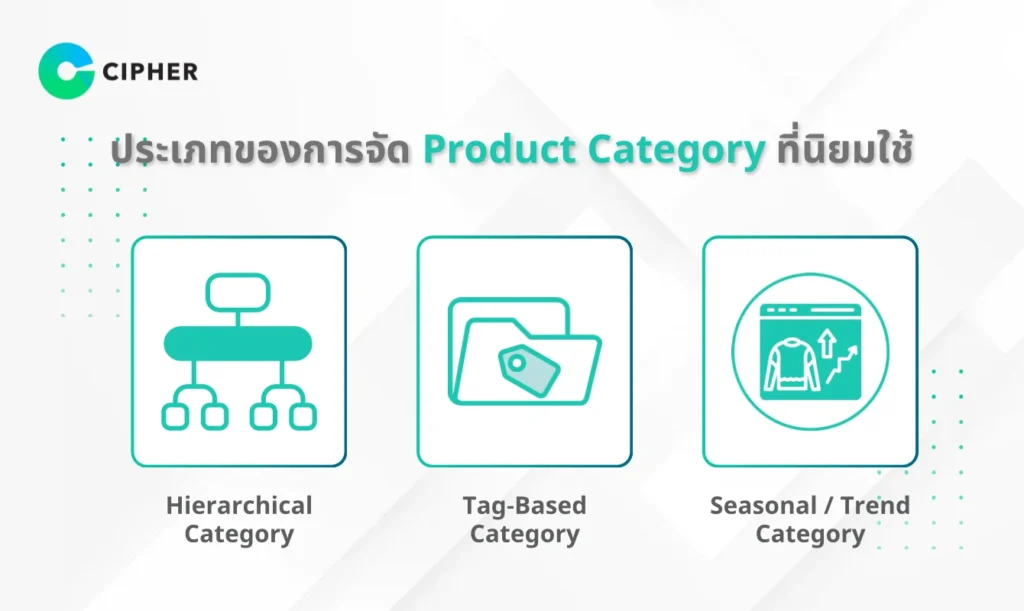
Hierarchical Category – Main Category > Subcategory
This is the most common format, structured in a hierarchical manner:
- Main Category (Parent Category) – e.g., Clothing, Electronics, Home Appliances
- Subcategory – e.g., Clothing >> Men’s Clothing >> T-shirts
- Sub-subcategories as appropriate
The advantage of this approach is that it’s easy to understand, similar to the folder structure on a computer, allowing customers to filter their desired products step by step.
Tag-Based Category – Organized by Properties or Keywords
This categorization method uses tags or product features to group items. A single product can belong to multiple categories:
- Tags based on properties – e.g., Waterproof, Energy-efficient, Organic
- Tags based on usage – e.g., For Exercise, For Travel
- Tags based on customer groups – e.g., For Children, For Seniors
This system works well for products with diverse features, allowing customers to discover products from multiple perspectives.
Seasonal / Trend Category – Organized by Seasons or Trends
Another interesting categorization method is organizing by time periods or popular trends:
- By festivals – e.g., New Year Products, Valentine’s Day Items, Chinese New Year Goods
- By seasons – e.g., Summer Fashion, Rainy Season Equipment
- By current trends – e.g., Low-carbon Products, Viral Social Media Items
This categorization creates freshness in your storefront and makes customers feel that your store is always up-to-date.

How to Create Effective Product Categories
Study Customer Behavior (Customer Journey)
Before categorizing products, you need to understand how your customers shop:
- What search terms do customers use most frequently?
- What factors influence their purchase decisions (price, brand, features)?
- What is the sequence of their decision-making process?
- Which products are commonly purchased together?
Analyzing this data helps you categorize products according to actual customer buying behavior, not just your own assumptions.
Use Simple, Straightforward Language
Category names should be immediately understandable to customers. Avoid overly technical terms or jargon:
- Use everyday terms that customers are familiar with
- Avoid abbreviations that might cause confusion
- Use terms that match what customers search for on Google
- Maintain consistent terminology across all categories
Remember, a good product category is one that customers don’t have to think twice about what it means.
Avoid Too Many or Too Few Categories
Finding the right balance in the number of categories is important:
- Too few categories: Results in too many products per category, forcing customers to spend time searching
- Too many categories: Causes customer confusion and may result in categories with too few products to appear interesting
Generally, main categories should not exceed 7-10 items for ease of memory and use. Subcategories should have an appropriate number based on the quantity of products.
Create SEO-Friendly URL Structures
Good URL naming helps both customers and Google. Use URL structures that reflect category hierarchy, include important keywords in URLs, avoid meaningless numbers or letters, and keep URLs concise. Easy-to-read URLs help both people and search engines better understand page content, such as /product-category/clothing/t-shirts.
Use Breadcrumbs, Filters, and Search to Support Product Categories
Beyond categorization, you should have supplementary functions that help customers find products more conveniently:
- Breadcrumb Navigation: Shows navigation path, e.g., Home >> Clothing > >Men’s Clothing >> T-shirts
- Filters: Allow customers to filter products by various properties like price, color, size
- Search Function: Have an intelligent search system that understands various search terms
These functions work with product categories to help customers find what they want as quickly as possible.
Design Your Website More Effectively with Experts from CIPHER!
Website & E-Commerce Design with User-Friendly Product Category Systems
CIPHER’s team not only offers E-Commerce website design and development services that look great but also prioritizes practical usability. We design product category systems that are:
- Easy to understand for all user groups
- Flexible, supporting future category additions/removals/modifications
- Displaying well on all devices (Responsive Design)
- Supporting Thai and other languages completely
We specialize in multiple platforms, including WordPress, WooCommerce, Shopify, and others to suit your specific business needs.
Restructuring Categories to Support SEO and Google SGE / AI Search
Search technology is changing rapidly, especially with the advent of AI like Google SGE. CIPHER’s team will help:
- Analyze and optimize your website’s category structure to match latest search behaviors
- Add category descriptions with appropriate keywords
- Increase chances of your category pages appearing in Rich Results
- Optimize data structure with Schema Markup so Google’s AI better understands your content
All this ensures your website is not only user-friendly for humans but also “friendly” to Google’s AI.
Connect Product Categories with Inventory and ERP/POS Systems
Good back-end management is key to online business success. CIPHER can:
- Connect product category systems with real-time inventory systems
- Integrate with your business’s existing ERP system
- Connect with POS systems to unify in-store and online sales
- Create sales analysis reports by category for business planning
Summary
Efficient Product Category organization is more than just arranging your store; it’s a crucial strategy that enhances customer experience, increases sales opportunities, helps with SEO, and systematizes inventory management.
If you want to upgrade your website and product category system, CIPHER is ready to be your partner in achieving online success. With our team of experts who understand both technology and marketing, we’re ready to help your business grow exponentially!

Frequently Asked Questions
What is a Product Category?
How are Product Categories important for SEO?
How many product categories is appropriate?
What negative effects result from poor product categorization?
Poor product organization can lead to various negative consequences:
- Customers can’t find products and leave the site (high Bounce Rate)
- Reduced opportunities for Cross-Selling/Up-Selling
- Difficult inventory and back-end management
- Poor SEO ranking due to unstructured website organization