

If you’re struggling with ranking your website on Google in 2025, don’t give up just yet! Today, I’ll share easy-to-understand methods to categorize websites effectively in the current AI Search era. Even non-IT professionals can implement these strategies. These insights come from our experience at CIPHER Digital Marketing Agency, where we’ve helped numerous businesses successfully improve their website categorization for better search visibility.
Table of Contents
What is AI Search? Why Should You Adapt in 2025?
AI Search is a system that uses artificial intelligence to understand search queries, analyze intent, and display results that best match users’ needs. Whether it’s Google AI, Bing AI, or ChatGPT, these technologies are transforming how people search for information in 2025—from typing just “keywords” to having more natural “conversations.”
Why adapt? Simply put, if your website isn’t properly categorized in an AI-friendly way, you’ll disappear from search results in today’s landscape. People no longer just click through the top 10 results—they read the summaries that AI provides! Learning to optimize your site structure for AI SEO has become crucial for business success in 2025.
Differences Between Traditional SEO and AI Search Optimization
Traditional SEO focuses primarily on ranking in Google using keywords and links, but AI Search Optimization requires a different approach. It’s about making AI “understand” your content, not just identify keywords. Effective website categorization has become a key factor that helps AI better comprehend your site’s purpose and organization.
AI specifically looks for:
- Clear website category structure (not just keyword stuffing)
- Content that directly answers questions with easily accessible categories
- Structured data that AI can easily interpret
- Fast, clean, and user-friendly websites

Who Is This Content For?
This article is suitable for several groups:
- Small to medium business owners looking to improve website categorization for increased online discoverability with limited budgets
- Digital marketers wanting to update their knowledge of effective site organization for the latest AI Search technologies
- E-commerce managers seeking to optimize product categorization for easier customer searches
- Website beginners who want to establish correct site organization foundations from the start
Even if you don’t have extensive technical knowledge, this article will help you understand the basic principles and start improving your website for the AI Search era immediately.
8 Ways to Categorize Websites for AI Search Success
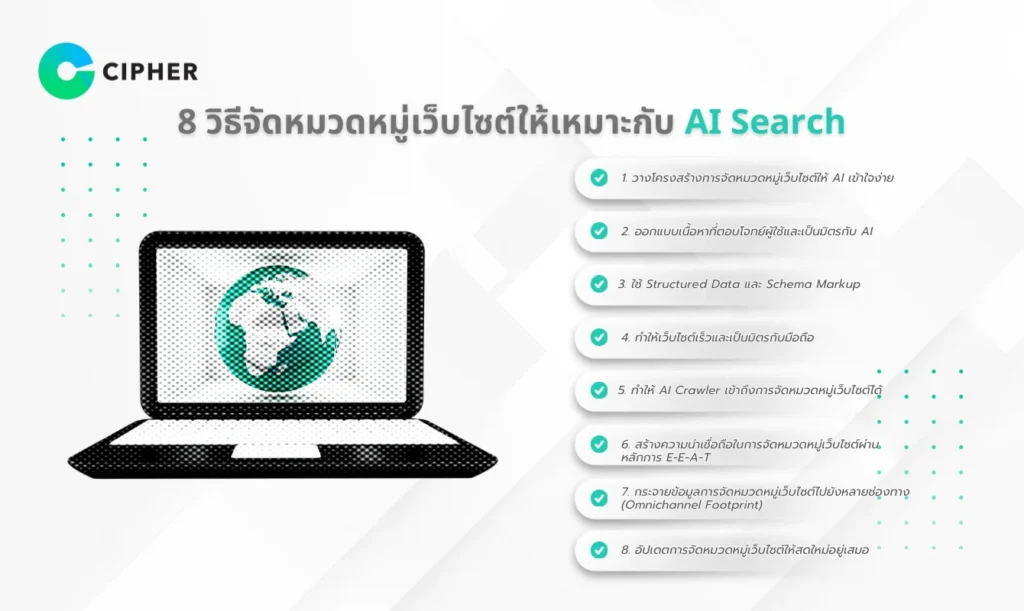
1. Structure Your Site to Help AI Categorize Websites Easily
Clear website organization helps AI “navigate” your site efficiently, similar to organizing a store to help customers find products easily. You should:
- Create short, concise URLs that indicate content, e.g., example.com/blog/how-to-categorize-websites
- Organize your site systematically, avoiding the common mistake of cramming everything in one place
- Create a comprehensive Sitemap and submit it to Google Search Console so AI understands your site structure
- Use Semantic HTML tags such as article, section, and nav to help AI understand your content hierarchy
2. Design Content That Meets User Needs and Is AI-Friendly
AI prefers content that directly answers user questions with in-depth and valuable information, not just surface-level writing. Good website organization helps structure your content systematically. Try these approaches:
- Focus on Q&A formats, How-to guides, or articles that solve specific user “pain points”
- Write clear headings and use proper subheadings (H2, H3) for organized content flow
- Pay careful attention to Search Intent—write to match what users are actually searching for, not just to include keywords
- Avoid duplicate content or copying from other sources
For example, instead of just writing “Website Tips,” try “How to Categorize Websites for Online Stores to Help Customers Find Products Easily” and provide comprehensive answers. A well-designed e-commerce platform will help you organize your site more effectively.
3. Use Structured Data and Schema Markup
Structured Data is essentially “tagging” each section of your site to tell AI what it represents, making it easier for AI to understand your structure and content. Several types are particularly valuable:
- Article Schema for informational content and blog posts
- FAQ Schema for frequently asked questions
- Product Schema for e-commerce product pages (including price, reviews)
- Event Schema for activities or promotions
- HowTo Schema for instructional guides and tutorials
Using Schema Markup increases your chances of appearing in Rich Results in Google and improves the likelihood that AI will pull information from your website to answer user questions, effectively increasing conversions with AI SEO.
4. Make Your Website Fast and Mobile-Friendly
AI typically takes only 1-5 seconds to extract information from websites. If your site loads slowly, AI might skip it entirely! Additionally, your site must display properly on mobile devices since most people use smartphones to search for information. Ways to increase speed include:
- Using a CDN (Content Delivery Network) to reduce loading time
- Compressing images to smaller file sizes while maintaining good quality
- Enabling Browser Caching to avoid reloading files repeatedly
- Reducing complex JavaScript that might slow down page rendering
- Testing with Google PageSpeed Insights and addressing issues according to recommendations
- Implementing Responsive Design that automatically adjusts to any screen size
Having a professionally designed website will help ensure your site loads quickly and is friendly to both users and AI systems.
5. Make AI Crawler Access to Your Website Easy
If you want your website to appear in AI Search results, don’t block AI Crawlers and manage your robots.txt file appropriately:
- Allow AI search bots to access your content, including OAI-SearchBot, ChatGPT-User, PerplexityBot, FirecrawlAgent, and AndiBot
- Decide whether to allow or disallow AI crawlers used for training models, such as GPTBot and Google-Extended
- Avoid hiding important content behind “read more” buttons, as AI might not process content beyond them
- Use HTML more than JavaScript because AI reads HTML format more easily
Example of an appropriate robots.txt file:
Allow AI search and agents
User-agent: OAI-SearchBot User-agent: ChatGPT-User User-agent: PerplexityBot Allow: /
Prevent using data to train AI models
User-agent: GPTBot User-agent: Google-Extended Disallow: /
Allow Google and Bing
User-agent: Googlebot User-agent: Bingbot Allow: /
6. Build Credibility in Your Website Through E-E-A-T Principles
Google and AI Search prioritize the E-E-A-T principles (Experience, Expertise, Authoritativeness, Trust) when evaluating websites:
- Experience: Demonstrate genuine, practical experience in your field
- Expertise: Showcase your specialized knowledge and skills
- Authoritativeness: Establish your site as a reliable information source
- Trust: Build confidence in your brand and content
Ways to increase credibility include:
- Displaying the author’s background, experience, and expertise in relevant topics
- Reference credible sources
- Showcasing certifications, awards, or company achievements
- Creating a comprehensive “About Us” page with detailed information about your expertise
- Publishing high-quality articles that demonstrate genuine knowledge in your field
7. Distribute Your Content Across Multiple Channels (Omnichannel Footprint)
AI often retrieves information from multiple sources, so distributing your content across various channels will increase your visibility in search results:
- Maintain a website that serves as a central hub with systematically organized content
- Keep your Google My Business information complete and regularly updated
- Create social media content that aligns with your website’s topics and structure
- Publish articles about your expertise on other relevant platforms
- Use RSS Feed or API to make it easier for AI to access your content updates
8. Keep Your Website Content Fresh and Updated
AI typically selects the most up-to-date information to answer questions. Regularly updating your content will keep your site relevant for AI systems:
- Update your content to stay current with the latest industry trends
- Include publication and update dates in your articles
- Use Last Modified HTTP Header to notify when there are changes to your content
- Add new information about developments in your industry
- Fix errors or outdated information promptly
Case Study: Brands Successfully Using Website Categorization for AI Search Marketing in 2025
Moz: AI-Trusted SEO Expert
Moz effectively implements AI Search Marketing strategies in 2025 with clear website organization and creates in-depth content about SEO with reliable source references. Their content is often in Q&A, How-to formats, and provides solutions that actually solve user problems.
They consistently use Schema Markup to enhance content structure and regularly update their information, making Moz a frequent source that AI systems choose when answering SEO-related questions in 2025.
HubSpot: Capturing the Market with Strategic Content Organization
HubSpot has been highly successful in AI Search Marketing by systematically organizing their website and creating detailed content that answers questions about digital marketing. Their comprehensive coverage ranges from SEO fundamentals to advanced online sales techniques, making them one of the preferred sources that AI systems reference when addressing marketing questions.
They strategically use Schema Markup to support content structure and maintain regular content updates to ensure information remains current, resulting in the brand being frequently mentioned in AI Search answers.
When Should You Improve Your Website Categorization?
You should consider improving your website organization when:
- Your site contains a large amount of content but lacks proper structure, making it difficult for users to find information
- Your website traffic has decreased, especially following Google algorithm updates
- You notice high bounce rates, which may indicate users can’t find what they need
- You have new products or services that need to be introduced but don’t fit into existing categories
- Your business strategy or target audience has changed, requiring you to restructure your site
- Search trends have evolved, particularly in the growing AI Search era
Services to Help Optimize Your Website for AI from CIPHER
AI-Ready Website Structure Package
AI-Friendly Content Optimization Package
AI Search Website Analysis Package
Omnichannel Content Distribution Package
With experience in optimizing websites for many leading national brands across corporate sites, E-commerce, Applications, and Online Marketing, our quality team is ready to help your business stay ahead of competitors in the AI Search era of 2025.
Conclusion